Portfolio item number 1
Short description of portfolio item number 1

Short description of portfolio item number 1
Short description of portfolio item number 2
We develop a communication-efficient federated learning algorithm for multi-agent zeroth-order online optimization, enabling collaborative target tracking with collision avoidance under limited communication. We establish theoretical convergence guarantees under weaker assumptions than prior work and validate the approach through numerical experiments.
We develop a communication-efficient federated algorithm for distributed zeroth-order online optimization, motivated by multi-agent target tracking. Using error-feedback compression, the method achieves non-asymptotic convergence guarantees under significantly weaker assumptions than prior work, with convergence rates that are robust to compression.
We propose a score-based diffusion model that synthesizes realistic cardiac MRI phase maps from magnitude-only images, enabling reconstruction of raw k-space data from routinely archived clinical scans. The generated phase maps are further validated by training a deep learning reconstruction model.
This work addresses the scarcity of raw k-space MRI data by synthesizing realistic phase maps from magnitude-only MR images using conditional score-based diffusion models. The generated phase maps enable the creation of synthetic k-space datasets for training deep learning MRI reconstruction models. We show that models trained on the synthesized data outperform GAN- and smooth phase-based alternatives and achieve reconstruction quality close to training with real k-space data.
This paper introduces an anatomy-guided framework for weakly supervised abnormality classification in 3D medical images using radiology reports. By combining anatomical attention maps generated from segmentation and language models with a Mamba-based 3D classifier, the proposed method significantly improves classification accuracy and F1 score over existing approaches.
We present AGA3DNet, a report-grounded framework for 3D brain MRI subtype classification that integrates anatomical phrases from radiology reports as soft spatial priors. By combining anatomy-guided attention with a lightweight 3D CNN and multi-view xLSTM aggregation, AGA3DNet improves classification performance over strong 3D baselines while providing interpretable, anatomy-aware localization without requiring voxel-level annotations.
We introduce a localized normalized root-mean-square error (NRMSE) metric for evaluating deep learning-based cardiac MRI reconstruction. Unlike conventional global metrics, the proposed metric focuses on the cardiac region, providing a more sensitive assessment of reconstruction quality and model generalization across variations in scanners, imaging sites, field strengths, and contrast dose protocols.
We develop a foundation model-based approach for automated classification of stress first-pass perfusion cardiac MRI. By fine-tuning a cine CMR foundation model on multi-center stress perfusion data, our method enables accurate classification of normal and abnormal cases while improving robustness across heterogeneous imaging centers.
We fine-tune a vision foundation model pretrained on cine cardiac MRI for myocardial segmentation in stress first-pass perfusion (FPP) CMR. By leveraging prior knowledge of cardiac anatomy, the proposed approach achieves accurate segmentation with limited labeled FPP data and demonstrates strong generalization across multi-center datasets.
We develop RAMPAGE, an unbiased randomized extrapolation method for variational inequalities that eliminates the discretization bias of classical Extragradient methods. We further introduce a variance-reduced variant, RAMPAGE+, and establish convergence guarantees for root finding, constrained variational inequalities, and smooth convex-concave games, demonstrating improved theoretical and practical performance.
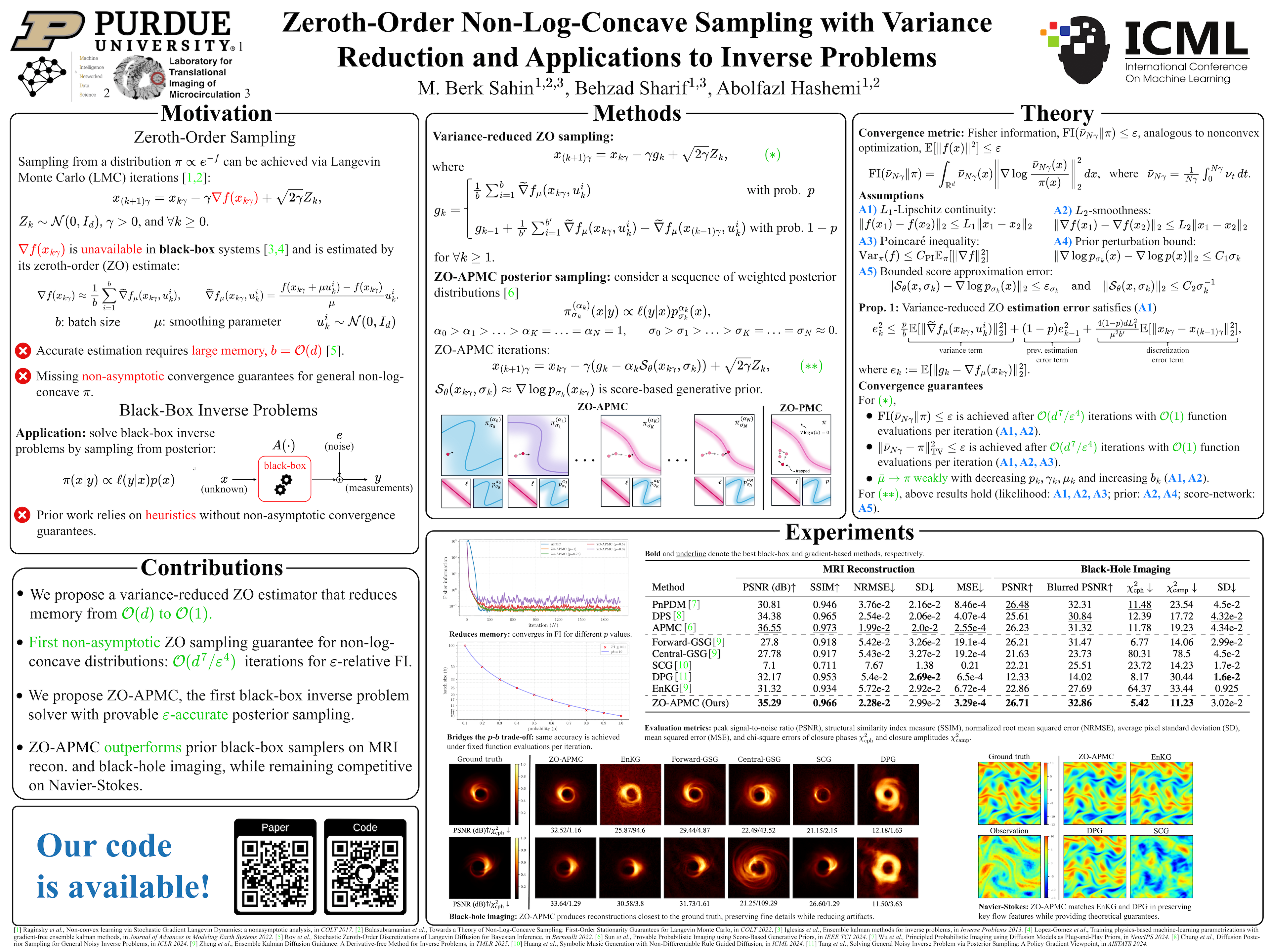
Developed the first provably convergent zeroth-order Langevin sampling algorithm for non-log-concave distributions, enabling efficient Bayesian inference when gradients are unavailable. Extended the framework to diffusion model–based posterior sampling for black-box inverse problems, achieving strong performance on MRI reconstruction, black hole imaging, and other scientific inverse problems.
We propose the largest-scale cardiac perfusion MRI foundation model trained on > 600,000 unlabeled multi-center images, achieving state-of-the-art performance for automatic segmentation with over 10-fold fewer manual labels, reducing reliance on manual annotation, and providing a reusable model for other tasks.
We develop a unified framework for stochastic variance-reduced estimation that encompasses classical methods such as SPIDER, STORM, and PAGE while motivating new estimators. Our analysis establishes dimension-free high-probability guarantees in both Euclidean and non-Euclidean settings and improves the oracle complexity of stochastic optimization with expectation constraints from \(\tilde{\mathcal{O}}(\varepsilon^{-4})\) to \(\tilde{\mathcal{O}}(\varepsilon^{-3})\).
Developed the first variance-reduced Langevin sampling algorithms with non-asymptotic convergence guarantees for non-log-concave distributions. Applied the framework to diffusion model–based Bayesian inference, achieving higher-quality posterior sampling and improved MRI and CT reconstruction under the same computational budget.
Published:
This is a description of your talk, which is a markdown file that can be all markdown-ified like any other post. Yay markdown!
Published:
This is a description of your conference proceedings talk, note the different field in type. You can put anything in this field.
Machine Learning Classes, Online Coding Course, 2015
Taught data science and machine learning courses, developed course materials, assignments, and coding notebooks, and mentored students participating in Kaggle machine learning competitions.
CS115: Introduction to Programming in Python, Bilkent University, Computer Science, 2020
Held office hours to support students with course projects and assignments in optimization for deep learning, and graded homework assignments and midterm exams.
ECE695: Optimization for Deep Learning, Purdue University, Electrical and Computer Engineering, 2024
Graded homeworks, midterms, and helped students’ project and assignments related to optimization for deep learning.